

This article is intended for informational purposes only and does not supersede or replace the official documentation provided by OpenText. It serves as supplementary guidance to assist with common challenges that may arise during installation and upgrades. For authoritative instructions and compliance requirements, refer to OpenText’s official documentation.
A data enrichment is a logic or learning based data manipulation which can run, for example, at the begin of a process. From a usage point it is very comparable with a logic module in the VIM Invoice process.
Please note that this article is not about the VIM Invoice process but VIM Solutions Beyond Invoice which is, for example, used to process sales orders, quotations, remittance advices, order confirmations or fully custom document processes (including capture & recognition using OpenText Intelligent Capture for SAP Solutions [IC4S]).
To be precise, Solutions Beyond Invoice describes the supplied solution packages, while the Foundation describes the creation of customised solutions, actions, rules and so on. For the sake of simplicity, I will refer to both as Solutions Beyond Invoice.
In the following steps I will describe how to create a logic based data enrichment for SAP VIM Solutions Beyond Invoice.
In case you are interested about learning based data enrichments please check the
OpenText Vendor Invoice Management for SAP Solutions – Configuration Guide for Foundation.
In case you are interested about using logic modules for the VIM Invoice process please refer to the OpenText Vendor Invoice Management for SAP Solutions – Configuration Guide for Invoice Solution.
VIM Solutions Beyond Invoice is formerly known as Business Center and sometimes referred to as VIM Beyond.
In earlier versions, data was changed with the help of business rules. This is becoming obsolete today and should therefore be avoided. Business rules check data, data enrichments change data. It is easy to convert old business rules into data enrichments.
Creating a data enrichment ABAP class
The initial step in this process is to create a new class that is both appropriately named and described, while adhering to the relevant naming conventions. You case use for example SE24 or SE80 to achieve this.
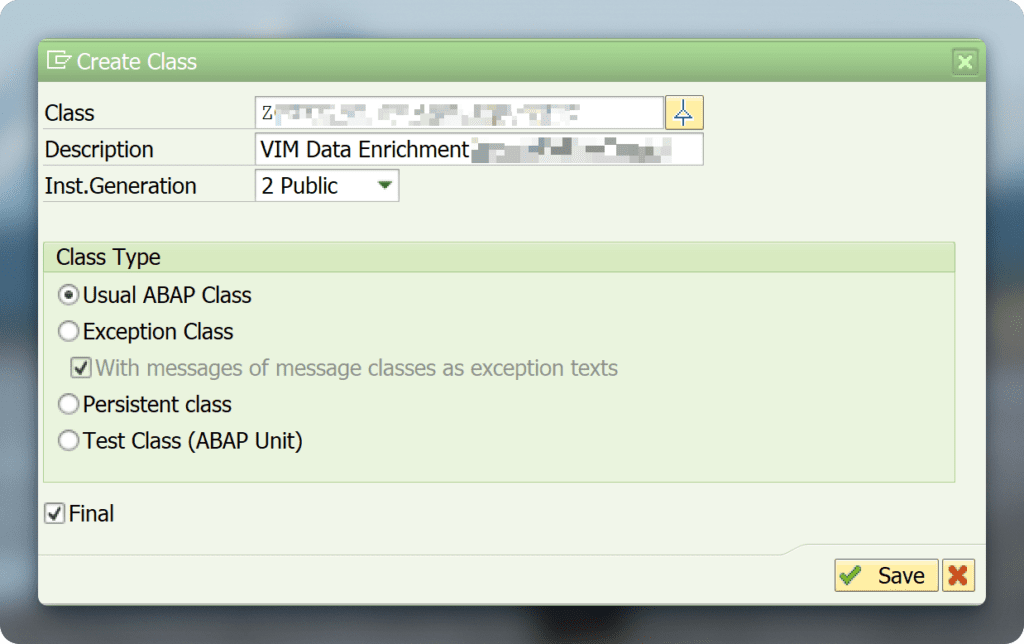
It is essential to add the correct interface for data enrichments. In the version I am working with, this is /OTX/PF04_IF_DATA_ENRICH_EX.
/OTX/PF04_IF_DATA_ENRICH_EX
The implementation is carried out in method /OTX/PF04_IF_DATA_ENRICH_EX~DATA_ENRICH_LOGIC.
/OTX/PF04_IF_DATA_ENRICH_EX~DATA_ENRICH_LOGICI use the following minimalist template for my projects. It already declares the structures, table and field symbol which are needed for processing header and line information. In addition, the success marker is set, if you forget this, the data enrichment is not even executed.
As the naming conventions for variables and the tables used change from project to project, I recommend creating this template once for each project.
If the data enrichment is only executed at the start of the process, it will be helpful to use a debug loop. But beware: If only the VIM Solutions Beyond Invoice Invoices solution is used in the system, but not the packages for invoice processing, a custom debug table in the style of /opt/cp_debug must be created.
METHOD /otx/pf04_if_data_enrich_ex~data_enrich_logic.
* Optional: Debug loop
DATA: ls_plh TYPE [...]_plh, " header table
lt_pli TYPE TABLE OF [...]_pli, " line item table
ls_msg TYPE bapiret2.
FIELD-SYMBOLS: Whenever data is changed, I recommend issuing a helpful and transparent message to users so that they know what has been changed and why. Here is an example of what such a message could look like in the code. You can of course also assemble the messages (ls_msg) manually, but I find the option mentioned here easier to read.
DATA ls_msg TYPE bapiret2.

" [...]

CALL METHOD /otx/pf02_cl_error_message=>message_return_build
  EXPORTING
    pi_type    = 'S' " "S" = Success / "E" = Error / "I" = Info
    pi_cl      = 'Z...' " name of your message class
    pi_number  = 019  " your message number.
    pi_par1    = " message parameter 1
    pi_par2    = " message parameter ...
    " [...]
  IMPORTING
    pes_return = ls_msg.

  APPEND ls_msg TO pet_return.
Customizing for a SAP VIM Solutions Beyond Invoice Data Enrichment
Now we have created the class for our data enrichment and still have to create the corresponding customising, which can be done very quickly in the transaction /otx/pf00_img.
/otx/pf00_imgNavigate to Process Configuration > Profiles:
Select your Profile Configuration and navigate to the corresponding Version Definition and then Data Enrichment Configuration. Here you can now create a Data Enrichment ID with a speaking name and description.
The enrichment point decides when a data enrichment should be executed. For my example I select ALL to execute it at all enrichment points.
Even if a data enrichment should only run at the beginning of the process, I like to use ALL at the beginning of my implementation because the jump to the debugger is super quick. Simply set a breakpoint in the class, execute the Enrich Data action and you are already in the ABAP Debugger and can analyse if everything is working according to plan.
The last step is often forgotten in data enrichments because it was not necessary in earlier versions. The newly created Data Enrichment ID must still be assigned to the corresponding Characteristics Configuration and given a sequence.
I have created a data enrichment but it is not working
If your data enrichment does not work, please check the following points:
- Is the success marker pe_success returned with true (‘X’)?
- Is the newly created Data Enrichment Configuration active? There is a checkbox on the far right which can easily be overlooked.
- Have you perhaps overlooked the last point Assign Data Enrichments?
- Perhaps your debug loop can help you here? If this is not activated, this can also be a finding.
Conclusion
When using SAP VIM Solutions Beyond Invoice, there is no getting round the use of data enrichments. Only with these can the process be properly tidied up and optimised.
Don’t forget to issue transparent and helpful messages for the users and make sure that the data enrichments run in a sensible sequence.
I wish you every success with the implementation!